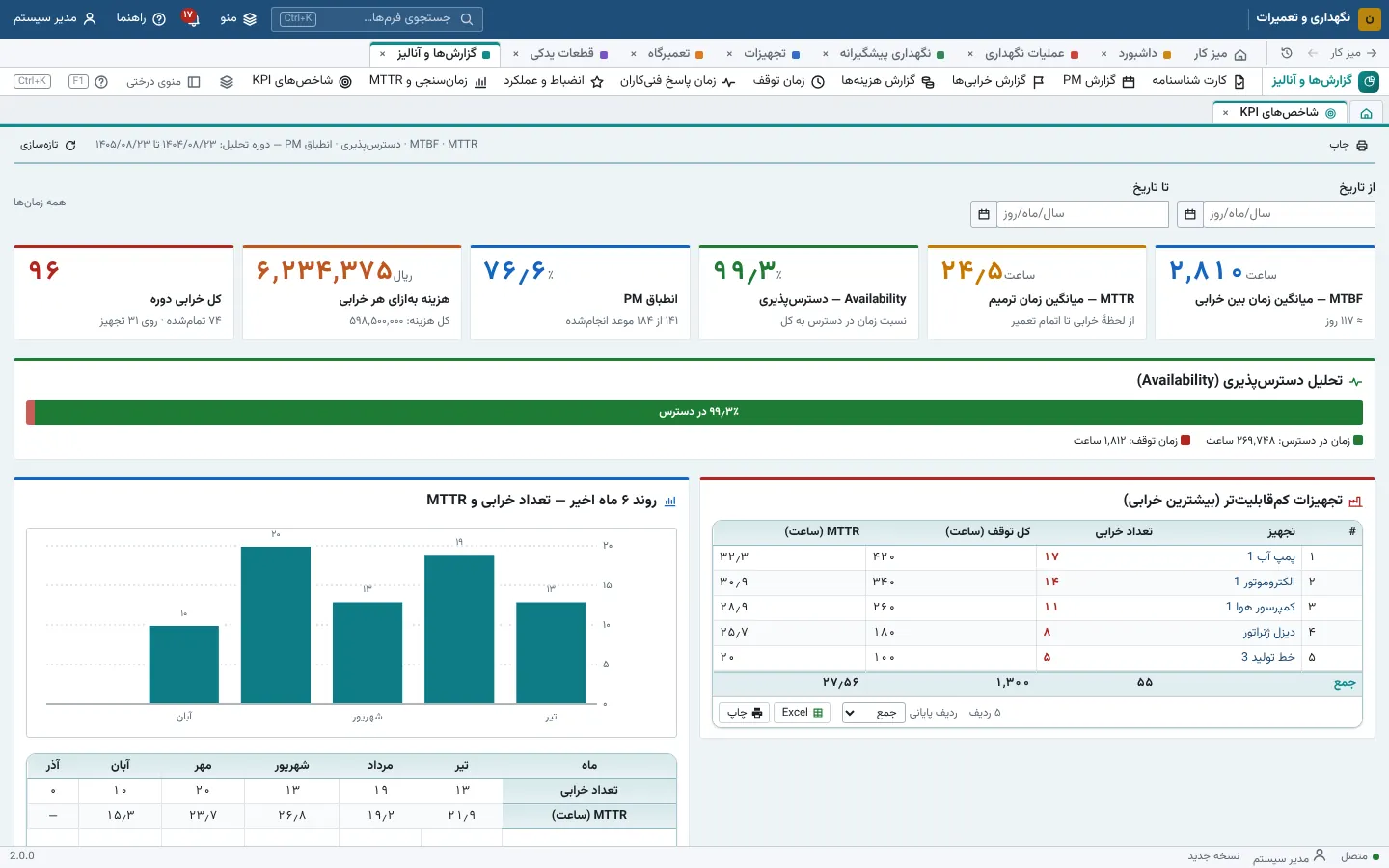
Mean time to repair (MTTR), mean time between failures (MTBF) and availability are the three core maintenance KPIs. See the definitions, formulas and how to improve each.
MTTR — mean time to repair
MTTR shows how long, on average, it takes to fix a failure:
MTTR = total repair time ÷ number of failures
A lower MTTR means a faster maintenance response. Repair time breaks down into time to assign, waiting to start (for example, for parts) and hands-on work. The Zana CMMS “Timing and MTTR” report shows these parts separately so you can see where the delay is.
MTBF — mean time between failures
MTBF tells you how long an asset runs, on average, without failing:
MTBF = total operating time ÷ number of failures
A higher MTBF means a more reliable asset. A falling MTBF signals a need to review the PM plan or rebuild the machine.
Availability
Availability is the share of time an asset is ready to run:
Availability = MTBF ÷ (MTBF + MTTR)
How to improve them
- Record times accurately — without breakdown, start and finish times no KPI is reliable.
- Regular preventive maintenance reduces the number of failures (higher MTBF).
- Fast access to spare parts shortens waiting time (lower MTTR).
- Failure coding reveals recurring root causes.
Zana CMMS calculates these KPIs automatically from real work-order data. Discover Zana CMMS